


I continue to learn… and the teachers come to me. In the light drizzle and brisk wind yesterday morning, a couple who stayed at my bed and breakfast pointed out edible mushrooms called boletes (aka boletus and cepes) growing in my woods, so this afternoon I went foraging.

The cap was recognizable, but David and Ellen had instructed me to look for a spongy, pore-filled underside …
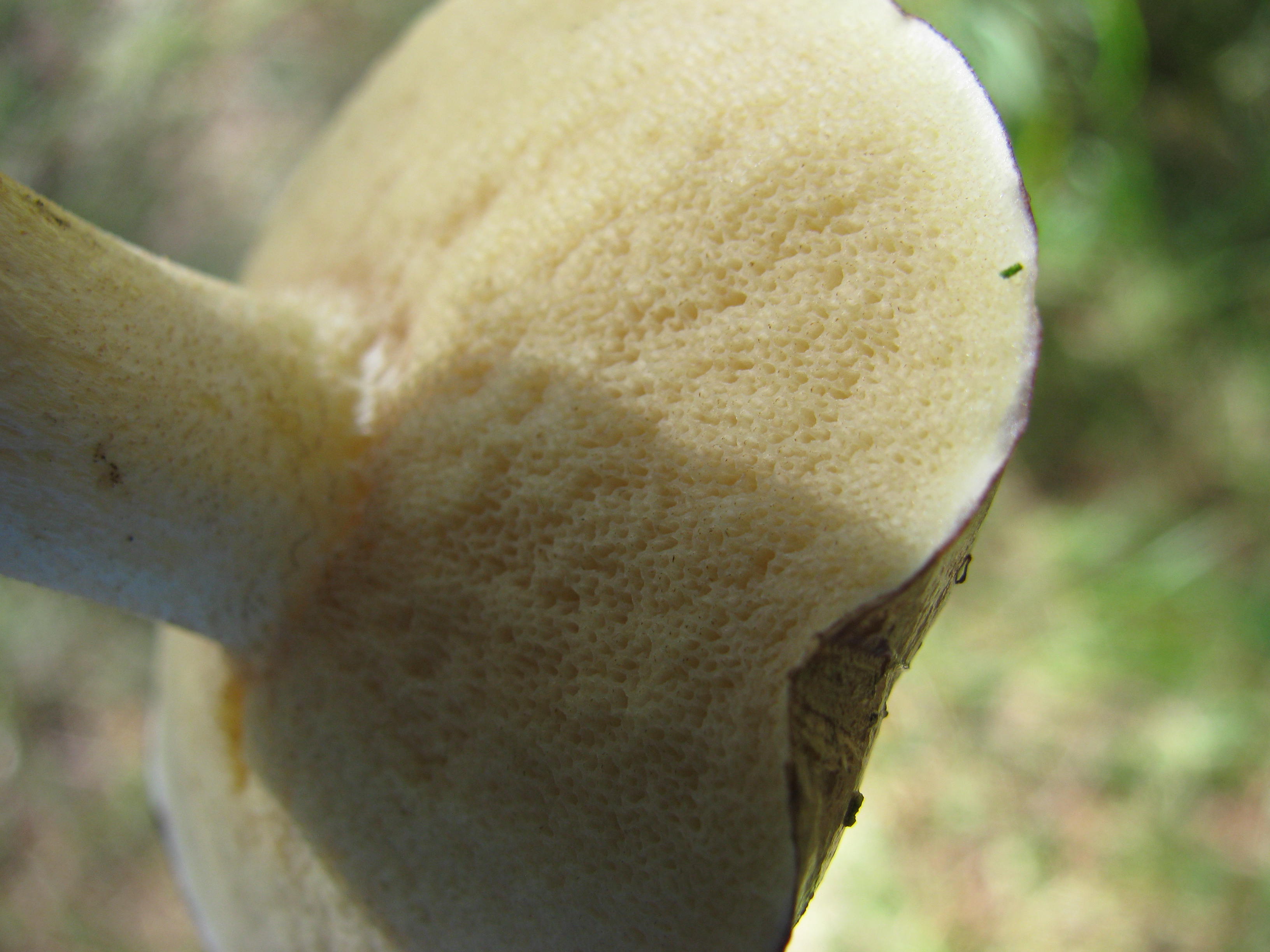
as opposed to having "bladelike gills" like many other, sometimes similar-looking, mushrooms.

When preparing them for cooking, the tough stems are removed and, in all but the youngest boletes, the spongy layer is peeled away. If the cap is slimy, the slime layer is peeled off because it sometimes causes diarrhea.

According to the Missouri Department of Conservation, when and where a mushroom grows is important in identification. Boletes are found in the summer and fall on the ground near or under trees, frequently under pines. Most look like a hamburger bun with a thick stalk… nice visual, the caps are usually brownish or reddish-brown, the pores (spongy, underside layer) may be whitish, yellow, orange, red, olive, or brownish, and they grow up to 10" tall with caps 1" to 10" wide. Boletes are considered safe for beginning mushroom collectors, but a few are poisonous. Don't eat any boletes that have orange or red pores (cap's spongy underside layer) as they are poisonous. I had intended to saute some boletes to add to my scrambled eggs for supper tonight. Dick was not going to partake. His cautiousness caused me to grow nervous at the last minute. Based upon what I learned from David and Ellen and the Missouri DOC site, I'm confident that I harvested the correct mushrooms, yet…

 Whiteley Creek Homestead
Leave a comment