


In the December 2012 issue of Taste For Life, a free magazine available at natural food stores, I found a Quinoa Protein Brekkie Bowl recipe and learned a new slang term. "Brekkie" means breakfast. The recipe comes from The Karma Chow Ultimate Cookbook by Melissa Costello. I chose to sub half of the quinoa called for in the recipe with wild rice. Not just any wild rice. This wild rice is hand-harvested the old-fashioned way in Northern Minnesota. As one person guides a canoe through a bay where tall wild rice plants grow, another "holds two cedar sticks called knockers—one to bend the plants over the canoe's hull and the other to gently tap the grains from the seed heads, a labor-intensive technique that has hardly changed over hundreds of years." (Axelson, Gustave. "Native Harvest: Ojibwe Wild Rice Gathering in Minnesota." MidwestLiving Sept./Oct. 2012) Hand harvested wild rice readily plumps and softens in 20-25 minutes, unlike the wild rice that comes from cultivated (farmed) paddies which requires 1 hour or more. The Native Americans joke "that you know commercial rice has finished cooking when you drop a rock in the pot and the rock turns soft." This eloquently and accurately describes my experience. If reduced cooking time is not reason enough to purchase hand harvested wild rice, pesticides and fertilizers are applied to the genetically modified, machine harvested wild rice commonly sold in grocery stores. Hand harvesting promotes the continuation of the Native American culture and resists an industrialized food system that disregards environmental impact and the health of consumers. Enough said.

Wild rice is one of only two cereal grains that are native to North America. It is the state grain of Minnesota. (Note: Wild rice is technically a grass seed, not a grain.) I am blessed to live in Minnesota where hand-harvested, naturally organic wild rice may be purchased at local shops. However, it may also be purchased online from such sources as Northwoods Best that sells the one depicted in my photo above (shop carefully as cultivated rice is sold alongside hand harvested in this online storefront) and Native Harvest's White Earth Land Recovery Project. To support the White Earth Nation's efforts, I ordered some wild rice and fry bread mix today from their site. A trip to the Black Hills of South Dakota, where Dick and I had our first fry bread tacos, spawned a desire to make them in my own kitchen. Additionally, my research regarding wild rice uncovered the Minwanjige Cafe that serves traditional Ojibwe foods in a log cabin along a country road in Ogema, Minnesota near Detroit Lakes. The menu includes hominy and wild rice soup, buffalo chili, squash soup, and whitefish chowder. Wild rice pancakes (served with chokecherry syrup and locally harvested maple syrup), rhubarb bread, and sage biscuits are made with organic flours milled 100 miles north. An upcoming summer adventure, I think.


Red (left photo) and golden quinoa are the most common colors sold in grocery stores, but there are also black, orange, pink, and purple varieties. Red quinoa has a higher protein content than golden. Quinoa is coated with saponins, a bitter tasting, naturally occurring coating that repels birds during its cultivation. It produces soap-like foaming when quinoa is shaken in water. Most boxed/pre-packaged quinoa has been pre-rinsed for convenience, and cooking instructions suggest only a brief rinse before cooking, if at all. If quinoa has not been pre-rinsed, the first step is to remove the saponins, which requires either rinsing the quinoa under running water for several minutes in either a fine strainer or cheesecloth or soaking the grain in water for a few hours. Soaking causes the quinoa to germinate which boosts its nutritional value. Germination activates its natural enzymes and multiplies its vitamin content. Quinoa has a very short germination period. Soaking in a glass jar of clean water for only 2 to 4 hours is enough to make it sprout. The colors of wild rice (right photo) vary, as well. These were three that I had in my pantry. The Ojibwe would be proud of this use of their hand harvested wild rice. Quinoa Wild Rice Brekkie Bowl. I am appreciative of their efforts.
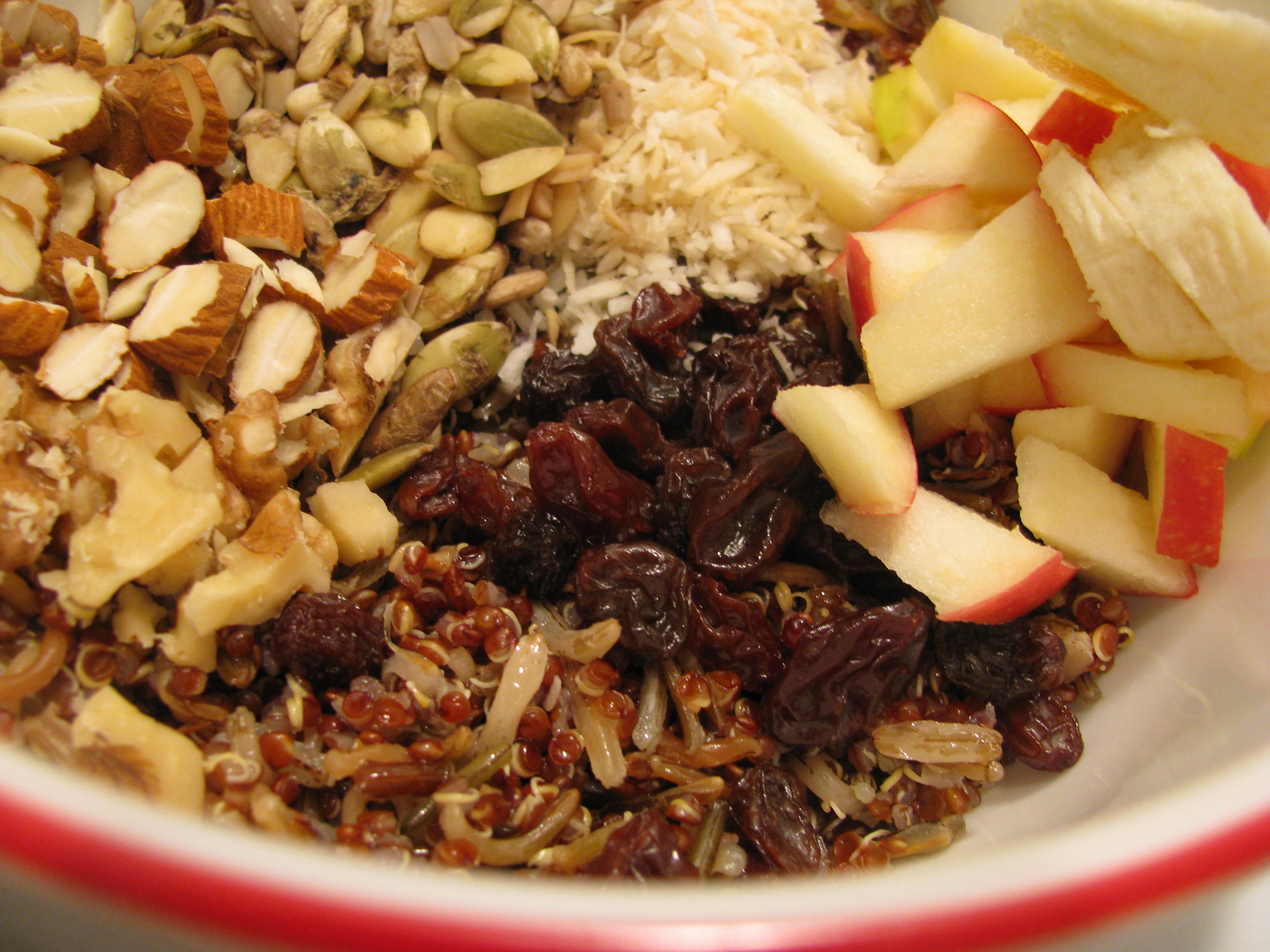
Quinoa Wild Rice Brekkie Bowl
Makes four ¾ cup servings.
1 cup rinsed quinoa (I used ½ cup quinoa + ½ cup hand harvested wild rice.)
¼ c toasted, unsweetened coconut flakes (I didn’t toast.)
¼ cup toasted slivered almonds (I sliced raw, unpasteurized whole almonds-untoasted.)
1 tbsp coconut oil (My addition. Fat aids nutrient absorption and helps liver remove toxins.)
pinch cardamom
1 tsp cinnamon
dash sea salt
1 tbsp agave nectar or maple syrup (I used maple syrup.)
¼ cup golden raisins (I used regular raisins.)
2 tbsp hemp seeds (I subbed sprouted, dehydrated sunflower
and pumpkin seeds.)
variety of fresh and dried fruit, nuts, and seeds
unsweetened almond milk or coconut milk (or your milk of choice)
Cook quinoa and wild rice in 1 ½ cups water simmered for 15 to 20 minutes until water is absorbed. Remove from heat. Let stand 5 minutes, then fluff with fork. While quinoa and wild rice is cooking, toast coconut and almonds by spreading on an ungreased, rimmed baking sheet. Bake at 350° for 5 to 10 minutes stirring once or twice, until golden brown. Remove from oven. When quinoa and wild rice is done cooking, add coconut oil, cardamom, cinnamon, sea salt, and agave nectar or maple syrup and mix together. Scoop into cereal bowls and top with coconut, almonds, raisins, hemp seeds (or sprouted, dehydrated sunflower and pumpkin seeds), and milk. (Additionally, I chose to top with diced apples, banana slices, chopped walnuts, and freshly ground flaxseed. Fresh blueberries, strawberries, pears, and peaches would be good, too. Oh, yum.)
Basic Wild Rice Cooking Directions:
In a large saucepan, add 1 cup rinsed wild rice to 3 cups water. Cover and simmer until tender 20-25 minutes. Yield: four ¾ cup or three 1 cup servings.
 Whiteley Creek Homestead
Leave a comment