


The Brainerd Public Library's "Brown Bag Summer Author Series" spawned the early beginnings of my efforts to uncover how Dick's grandmother is related to Thomas Edison. I was so excited to attend the series for my very first time on June 9, 2014 that I packed a special lunch the night before… in a brown paper bag, of course. I made a sandwich with thick slices of local, grass-fed, nitrite-free beef summer sausage and freshly harvested, locally grown greens from my CSA share along with hummus and celery for dipping. After scooping a large spoonful of Good Mornin' Apple Crisp into a half-pint mason jar, I was ready. I wondered, "Do people really pack a brown bag lunch or is it just a catchy name for the event?" I decided to tuck my bag lunch deep into my backpack until I could survey the attendees to see what others were doing. You know. The 'ol gotta-fit-in, junior high school mentality.


That particular day, Rhonda Fochs (pronounced Fox) was presenting her book, Minnesota's Lost Towns Northern Edition which includes "lost" towns in thirty-two counties in northern Minnesota. Her definition of a lost town is one that was "once a thriving heart of a community that has little or no population now." What caused the towns to fold? Rhonda shared several reasons… 1)RFD (Rural Free Delivery) In 1893, congress passed legislation to begin delivery of mail in rural areas rather than people coming to the post office to pick up mail. 2)Automobiles Faster modes of transportation meant people could travel further distances to shop for better prices and variety. 3)Railroads Prior to the invention of automobiles, passenger and supply trains made regular stops no farther apart than what a farmer could travel by horse in one day. With faster modes of transportation, the distance between rail stops increased resulting in a town's residents moving to the railroad hubs. 4)One-Industry Towns If a community is built around a single industry such as timber or mining, when the resources are depleted, the workers move and the town dies.

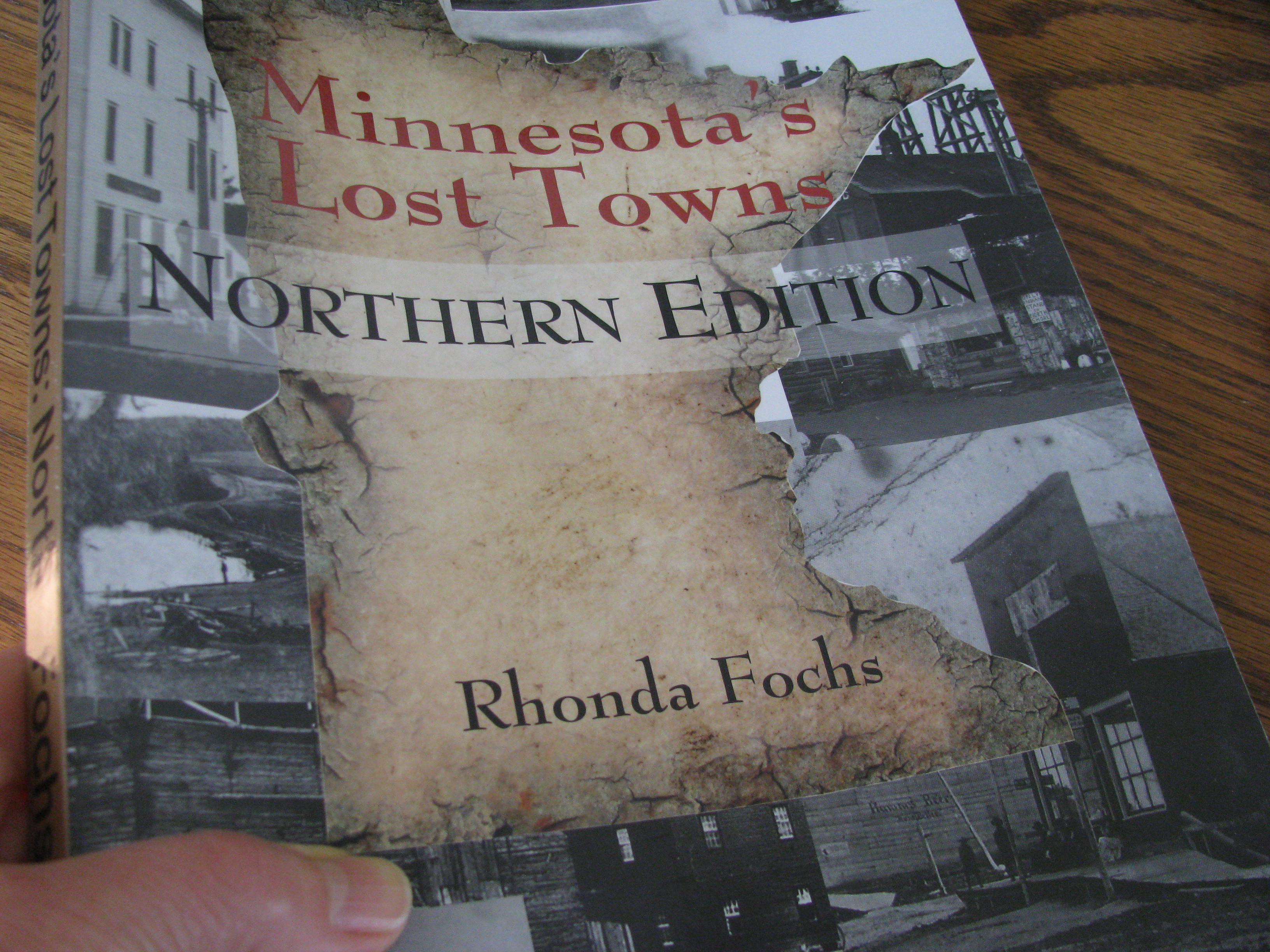
She had created a Power Point presentation to show us photos from her book of some lost towns in the Brainerd area. A black and white photo filled the large projection screen next to where she stood at her podium. It was of a woman walking down "Main Street, Woodrow, ca. 1914," the caption read. (See photo in book below.) Rhonda explained the significance of the town of Woodrow to the area's iron ore mining industry. In 1914, a woman named Olive Dullum (pronounced due-lum) and her husband, John, built a boarding house for mine workers in Woodrow northeast of Brainerd. My hand shot up to ask Rhonda if she knew the name of the woman in the photo. She did not.

As Rhonda moved on to the next lost town near Brainerd, I continued to wonder. Could it be? Was the woman in the Woodrow photo Dick's Grandma Dullum? I was well aware of the boarding house that his grandparents built and continued to live in until their deaths… I was inside it when Olive still resided there, but… the photo. Then, recently, one of my grandsons asked to see a photo of Dick and I when we were "hippies" in the early 70s. As I rummaged through some photos, there it was… the same photo as in Rhonda Foch's book, Minnesota's Lost Towns, with a caption typed underneath confirming that it was Dick's Grandma Dullum.
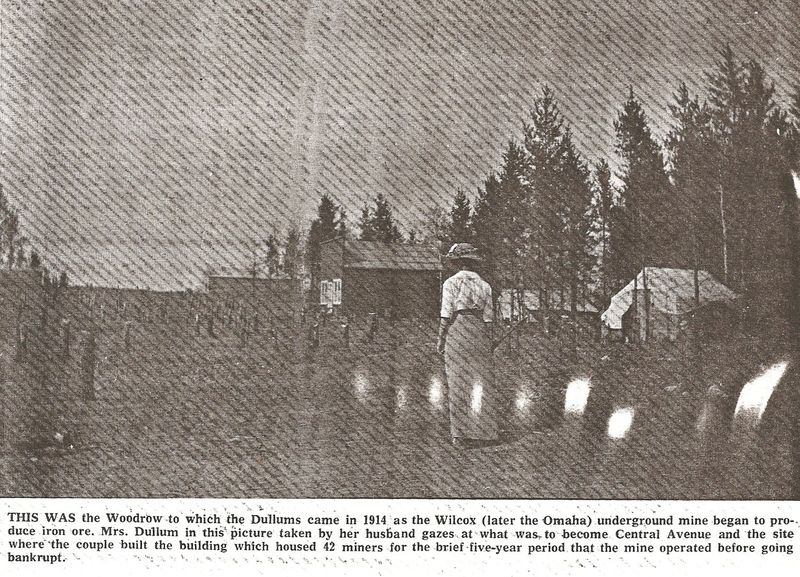
Dick told me that his Grandpa Dullum's hobby was photography. On the second floor… the last room down the hall on the right at the back end of the boarding house facing the barn, he remembers a storage room that held photo supplies and equipment alongside beekeeping boxes and frames. The room had been transformed into a dark room where his Grandpa Dullum developed pictures. This remembrance validates the photo's caption. And, yes, despite only a handful of others eating from bag lunches, I reached deep into my backpack and pulled out my lunch.
 Whiteley Creek Homestead
Leave a comment