


A tarp secured with bungees to outmatch the force of wintry winds covers our greenhouse, emptied rain barrels are turned upside down, late season veggies have been gathered, and dried vines removed. With the closure of this year's gardening season, it is time to celebrate the harvest measured by what our garden has provided to carry us through the winter months.

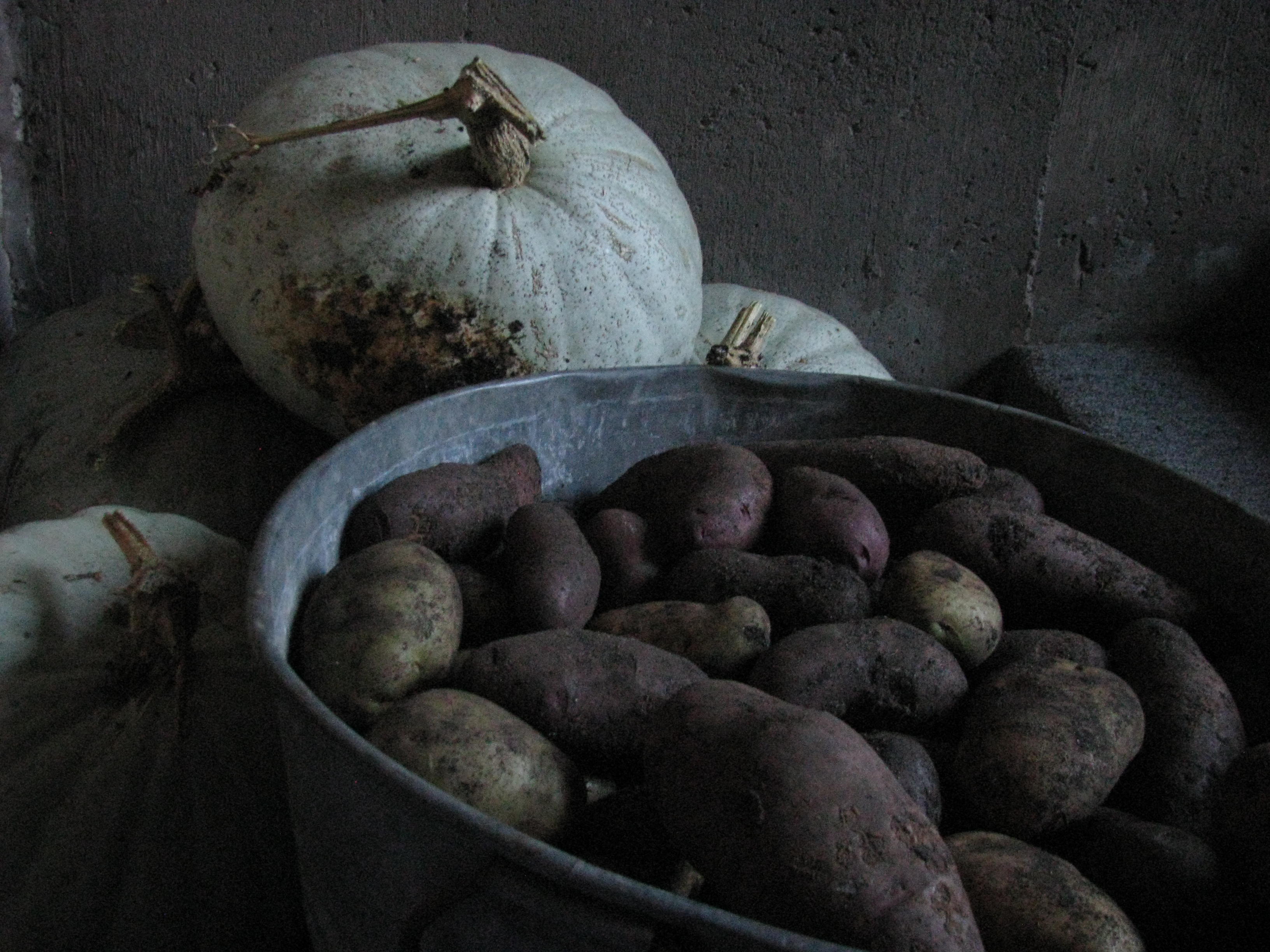
We have four hefty heirloom Sweet Meat Hubbard Squash, a bushel of predominantly large-size purple, red, and white potatoes stored in a quite dark, cool basement entry, and four overstuffed gallon bags of sliced green tomatoes in the freezer for pies. I was so hopeful of an abundant dry soup bean harvest, but deer jumped the wooden fence surrounding my garden space to eat all but the uppermost vines hanging out of reach upon the trellises they clung to. It is counterproductive to think that we inhabit the earth in isolation or have dominion over the creatures that inhabit our space, so, in the spring, we will install an electric fence above our garden posts to deter the deer. My rhubarb was spindly this year, so there was not enough to freeze for winter consumption. I will add compost and manure, gleaned from cattle raised properly, around our rhubarb because the plants have faithfully produced for many, many years in the same location, so the soil's nutrients have been depleted. Possibly transplanting to an alternate location is prudent. Although large in size, with prized deep orange flesh, the low yield in relation to space required of Sweet Meat Squash must be considered if garden size is limited. After sprawling across available garden soil, my vines trailed onto nearby bean trellises. I may consider a designated arched support to maximize available space. Alongside successes, one must evaluate failures. That is how we learn and become better at our craft. By devising solutions, we become less frustrated with wildlife and find peace in coexisting. Over time, soil amendments exhibit substantial results. We steadily increase our yield using space and time more efficiently. There is comfort in knowing that we are not alone in our struggles, as Kurt Timmermeister candidly documents in his book, Growing a Farmer, which I am presently reading. Farming, whether it be large or small scale, is hard work. Sometimes the rewards are less than hoped for, but nonetheless satisfying.

 Whiteley Creek Homestead
Leave a reply to Jessie Cancel reply